
MINECRAFTBIBLE
Loading...
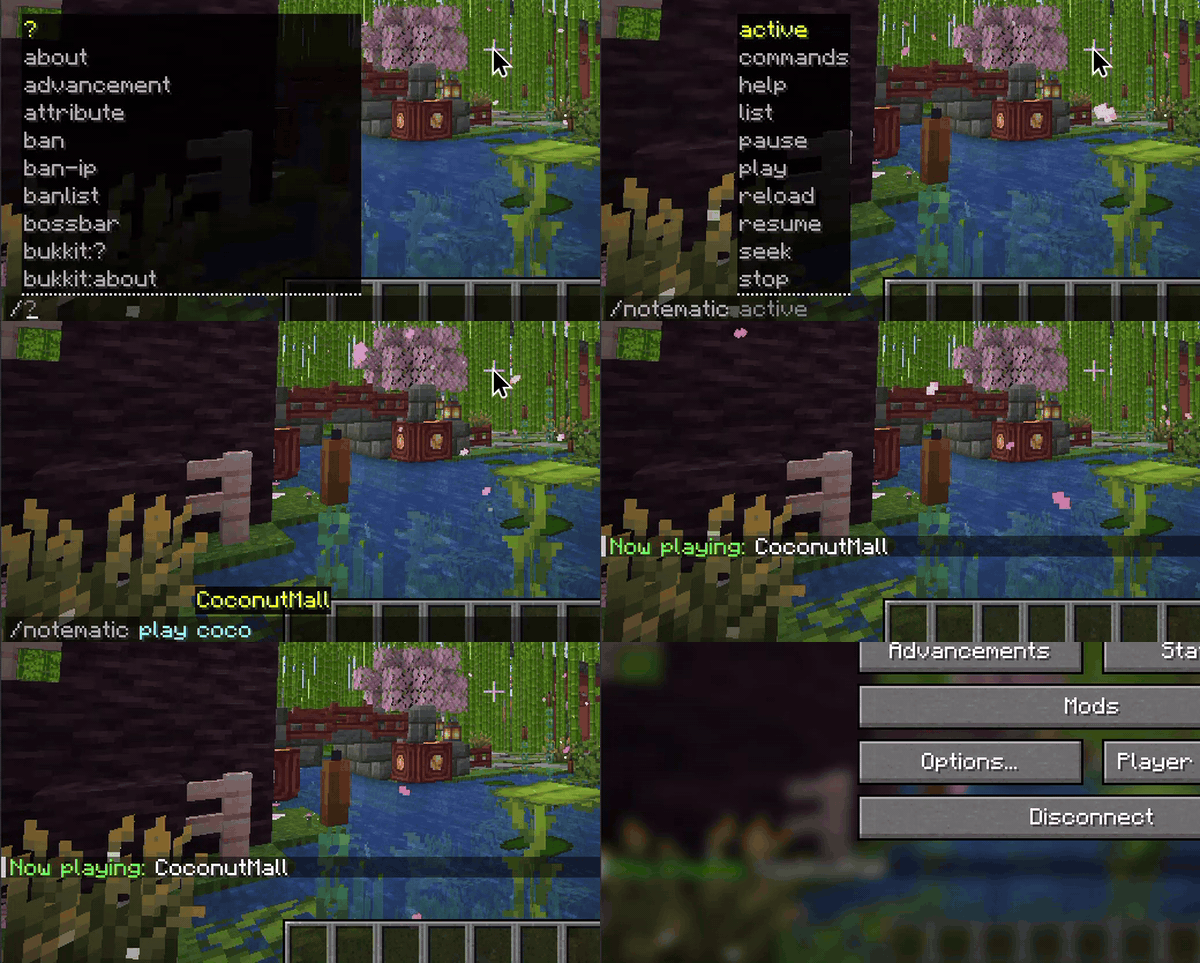

A companion Minecraft audio player plugin and API that plays custom note block music sequences exported from Notematic Studio with offline sync, multi-song playback, and per-player volume settings.
Notematic Player is a Minecraft Java plugin designed as the companion player for Notematic Studio. It plays custom note block music sequences exported from the studio in .json or .mcfunction formats directly to players or positionally in the world. Beyond standard note block sounds, it can also play any in-game /playsound audio (including custom resource pack sounds) directly.
/notematic volume <val> (saved by UUID).An official sub-addon built on top of Notematic Player's engine. It uses Digital Signal Processing (DSP) to analyze Text-to-Speech audio, extract formant frequencies, and dynamically map them to Minecraft's sound system, allowing note blocks to "talk" in real-time.
/<command> <prompt>.| Command | Permissions | Short Description |
|---|---|---|
/notematic [help] |
notematic.use |
Displays plugin info, status, and commands menu. |
/notematic play <song> [target] [loop] |
notematic.usenotematic.play.location (for at ...)notematic.play.loop (for loop) |
Plays a song for yourself, a target player, everyone, or positionally at a 3D location. |
/notematic stop [#ID | song | player] [at <x> <y> <z>] |
notematic.use |
Stops active playbacks (by ID, song, player, or coordinate). |
/notematic seek <#ID | song | player> <value> |
notematic.use |
Seeks forward, backward, or to an absolute time in a playback. |
/notematic pause [#ID | song | player] [at <x> <y> <z>] |
notematic.use |
Pauses active playbacks. |
/notematic resume [#ID | song | player] [at <x> <y> <z>] |
notematic.use |
Resumes paused playbacks. |
/notematic volume <value> |
notematic.use |
Sets your own personal listening comfort volume (0-100%). |
/notematic volume #ID <value> |
notematic.use |
Sets a temporary volume multiplier for a specific active playback instance. |
/notematic volume song <name> <value> |
notematic.admin |
Sets a song's global volume multiplier (Admin only). |
/notematic list |
notematic.use |
Lists all loaded public (and private if admin) songs. |
/notematic active |
notematic.use |
Shows all currently playing songs with real-time status. |
/notematic commands [true | false] |
notematic.admin |
Toggles or sets player command usage globally (Admin only). |
/notematic reload |
notematic.admin |
Stops all active songs and reloads the song folder (Admin only). |
Starts playing a song. Playback can target yourself, other players, all online players, or a physical 3D location in the world.
/notematic play <song> — Play for yourself./notematic play <song> [player] — Play for a specific player (Admin required)./notematic play <song> <@a | * | all> — Play for all online players (Admin required)./notematic play <song> at <x> <y> <z> [radius] [volume] [loop] — Play at specific coordinates. Sounds play positionally. Supports relative ~ coordinates./notematic play test_song/notematic play test_song loop (looping infinitely)/notematic play test_song at ~ ~ ~ 15 50% loop (looping at your position, 15 block hearing radius, 50% volume)Stops active playbacks. Resolved dynamically in search order:
#ID): Stops a specific instance (e.g. /notematic stop #3)./notematic stop/notematic stop #12/notematic stop test_song/notematic stop at ~ ~ ~ (Stop location-based playbacks at current coordinates)Seeks playbacks forward, backward, or to an absolute time.
+10s (forward 10s), -5s (back 5s), +200t (forward 200 ticks).30s (jump to 30s mark), 150t (jump to tick 150)./notematic volume <val>): Sets comfort listening level. Saved by UUID in player_volumes.yml./notematic volume #ID <val>): Sets temporary volume multiplier of a specific playback instance./notematic volume song <name> <val>): Sets base volume level for a song. Stored in volumes.yml.baseNoteVolume * songVolumeMultiplier * personalPlayerVolume.Notematic Player runs entirely server-sided, meaning vanilla clients do not need to install any mods to hear the music. It is natively compatible with 1.20.6 and 1.21 - 26.1.x on:
Place your music files in plugins/NotematicPlayer/songs/.
/songs/ or /songs/public/): Accessible to anyone via /notematic list and play commands./songs/private/): Only accessible to OPs/admins (or players with notematic.admin).{
"tempo": 1.0,
"notes": [
{
"instrument": "harp",
"note": 1.4142,
"volume": 0.8,
"when": 0
},
{
"instrument": "bass",
"note": 0.7071,
"volume": 0.6,
"when": 5
}
]
}
tempo: Speed multiplier (double). 1.0 plays at normal speed.notes: Array of note events, sorted by when.instrument: Instrument name (e.g. harp, piano, bass, bell, flute, guitar, pling, bit, banjo). You can also use any in-game /playsound identifier (e.g., minecraft:entity.cow.ambient, minecraft:block.bell.use, or custom resource pack sounds) by specifying a key containing a ., :, or /.note: Pitch multiplier from 0.5 to 2.0.volume: (Optional) Note-specific volume from 0.0 to 1.0.when: Tick delay relative to the start.If you drop an .mcfunction file into the songs folder, the plugin scans for storage modifications to parse the JSON:
data modify storage music sheet set value {"tempo":1,"notes":[{"instrument":"harp","note":1.4142,"when":0}, ...]}
Retrieve the plugin instance from Bukkit's plugin manager:
import me.cayde26.notematicPlayer.NotematicPlayer;
import org.bukkit.Bukkit;

NotematicPlayer api = (NotematicPlayer) Bukkit.getPluginManager().getPlugin("NotematicPlayer");
if (api != null && api.isEnabled()) {
    // Play a song positionally for a player without chat messages
    api.playSong(player, "mysong", false, true);

    // Stop active playbacks for a player
    api.stopSong(player);

    // Get/set a player's personal volume multiplier
    double playerVol = api.getPlayerVolume(player);
    api.setPlayerVolume(player, 0.85);
}
boolean playSong(Player player, String songName)boolean playSong(Player player, String songName, boolean showChatMessage)boolean playSong(Player player, String songName, boolean showChatMessage, boolean positional)boolean playSong(Player player, String songName, boolean showChatMessage, boolean positional, String initiator)boolean playSongForAll(String songName)boolean playSongForAll(String songName, boolean showChatMessage)boolean playSongForAll(String songName, boolean showChatMessage, boolean positional)boolean playSongForAll(String songName, boolean showChatMessage, boolean positional, String initiator)void stopSong(Player player)void stopSong(Player player, String songName)void stopAllSongs()void pauseSong(Player player)void pauseSong(Player player, String songName)void resumeSong(Player player)void resumeSong(Player player, String songName)void pauseAllSongs()void resumeAllSongs()boolean isPlaying(Player player)boolean isPaused(Player player)boolean songExists(String songName)List<SongPlayback> getActivePlaybacks()double getSongVolume(String songName)boolean setSongVolume(String songName, double multiplier)double getPlayerVolume(Player player)void setPlayerVolume(Player player, double volumeMultiplier)

