
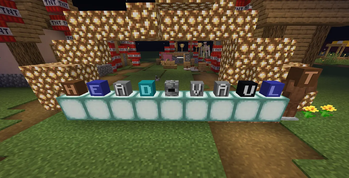

head-vault
A server-side Fabric mod for Minecraft 26.1.2 that lets players browse and purchase 90,000+ decorative custom heads through an in-game GUI without requiring any client mods or resource packs.
📖About head-vault
🗿 HeadVault
A server-side custom-heads shop for Minecraft Fabric SMPs.
Browse 90,000+ decorative player heads in a clean chest GUI — open it with a command, a shopkeeper NPC, or a named villager. No client mods. No resource packs. Vanilla players just play.
Fabric · Server-side only
✨ Why HeadVault?
Custom heads make builds come alive — but handing them out one command at a time is painful. HeadVault turns the entire minecraft-heads.com catalog into an in-game shop your players can browse and buy from, however you want to run it: a command, a placed-down NPC, or a villager you name. It’s server-side only, so nobody needs to install anything to use it.
🎯 Features at a glance
- 🛒 A real shop GUI — categories → paginated head grid → click to buy. Renders natively on vanilla clients.
- 🌍 The whole catalog — ~90k heads across 10 categories, fetched live and cached to disk. Refreshes in the background; never lags the server.
- 🔌 Always works offline — unreachable API? It serves the last cache, then a snapshot baked into the jar.
- 🔎 Search — find heads by name or tag across the entire catalog.
- 🙂 Player heads — type any username and get that player’s head as a clickable result.
- 🚪 Three ways in —
/headscommand, persistent shopkeeper NPCs, and named villagers. Mix and match. - 🧟 Any mob can be a trader (since 1.1.0) — not just villagers. Name-tag a zombie, a cow, anything, and make it a shop. Choose which mob types qualify via an allow-all, whitelist, or blacklist mode.
- 🧊 Freeze named traders (since 1.1.0) — opt-in: when a name tag turns a mob into a trader, lock it in place (disables AI) so it can't wander off, just like a spawned NPC. Reverts the moment you rename it back.
- 💰 Flexible economy — free, item cost, or experience (levels/points), with per-category pricing. Purchases are atomic.
- 📦 Heads stack — identical heads stack to 64.
- ♻️ Hot reload — tweak the config and run
/headvault reload. No restart. - 🔐 Permissions — LuckPerms-compatible, with sane vanilla-OP fallbacks when no permission mod is present.
- 🪝 Extensible — a
PurchaseEventother mods can listen to.
🚀 Getting started
- Requirements: a Fabric 26.1.2 server on Java 25, with Fabric API installed.
- Drop
head-vault-<version>.jarinto your server’smods/folder. (sgui and fabric-permissions-api are bundled inside — nothing else to install.) - Start the server. HeadVault writes its config to
config/headvault/config.jsonand begins downloading the head catalog in the background. - Run
/heads— and you’re shopping. 🎉
First launch shows a small built-in sample until the full catalog finishes downloading (a few seconds).
🚪 Access modes
Enable any combination in the config.
| Mode | How it works |
|---|---|
| Command | /heads opens the shop (permission-gated). |
| NPC | /headvault npc spawn <name> places an invulnerable, AI-less shopkeeper villager. It persists across restarts; right-click opens the shop. Manage with npc list / npc remove. |
| Named villager | Name any villager your configured name (default “Head Trader”) and right-clicking it opens the shop for everyone — no permission needed. Hold a name tag to rename it back to normal. Since 1.1.0: via access.villager.mode you can let any mob be a named trader — not just villagers (all / whitelist / blacklist); and access.villager.freeze can lock a fresh trader in place. |
💰 Economy
Pick one global mode (with optional per-category overrides):
| Mode | Players pay… |
|---|---|
FREE |
nothing |
ITEM |
a configurable item × amount (e.g. 1 diamond) |
XP_LEVELS |
experience levels |
XP_POINTS |
total experience points |
Every purchase re-checks the cost at click time and deducts atomically — players can never be charged without receiving their head. Player-name heads use the global price. Grant headvault.free-bypass to let someone shop for free.
⌨️ Commands
| Command | Description | Permission (default) |
|---|---|---|
/heads |
Open the shop | headvault.command.use (OP 2) |
/heads search <query> |
Search heads by name/tag | headvault.command.search |
/heads player <name> |
Get a specific player’s head | headvault.command.use |
/heads give <player> <head-id> |
Give a head for free (head-id = its UUID) | headvault.command.give / headvault.admin |
/headvault reload |
Reload the config | headvault.admin |
/headvault npc spawn <name> |
Spawn a shop NPC where you stand | headvault.npc.manage |
/headvault npc remove |
Remove the NPC you’re looking at | headvault.npc.manage |
/headvault npc list |
List loaded shop NPCs | headvault.npc.manage |
🔐 Permissions
| Node | Grants |
|---|---|
headvault.command.use |
Open the shop, /heads player |
headvault.command.search |
/heads search |
headvault.command.give |
/heads give |
headvault.admin |
/headvault reload, /heads give |
headvault.npc.manage |
Spawn / remove / list NPCs |
headvault.free-bypass |
Always pay nothing |
No permission mod? Command nodes fall back to the vanilla OP level, and NPC / named-villager modes work for everyone without any permission. With LuckPerms (or any provider) grant nodes normally:
/lp group default permission set headvault.command.use true
⚙️ Configuration
The config lives at config/headvault/config.json and hot-reloads with /headvault reload. (It’s JSON, not YAML — Gson under the hood.) Here’s the full file with every option:
{
  "_schemaVersion": 1,

  "catalog": {
    "source": "v1",                 // where heads come from: "v1" | "v2" | "bundled"
    "refreshIntervalHours": 24,      // how often to re-download the catalog
    "requestTimeoutSeconds": 15,     // per-request network timeout
    "maxRetries": 2,                 // retries per category before giving up
    "v2AppUuid": "",                 // v2 only: your registered App UUID
    "v2UrlTemplate": "",             // v2 only: custom endpoint; placeholders {category}, {appUuid}
    "userAgent": "Mozilla/5.0 ... Chrome/126.0.0.0 Safari/537.36"  // sent with requests (see note)
  },

  "economy": {
    "mode": "FREE",                  // "FREE" | "ITEM" | "XP_LEVELS" | "XP_POINTS"
    "item": { "id": "minecraft:diamond", "amountPerHead": 1 },
    "xp":   { "amountPerHead": 1 },
    "categoryOverrides": {
      // override price per category (key = category slug):
      // "monsters": { "mode": "ITEM", "item": { "id": "minecraft:netherite_ingot", "amountPerHead": 1 } }
    }
  },

  "access": {
    "command":  { "enabled": true, "permissionLevel": 2 },
    "npc":      { "enabled": true },
    "villager": {
      "enabled": true,
      "name": "Head Trader",
      "caseInsensitive": true,
      // ── since 1.1.0 ──
      "mode": "ONLY_VILLAGER",        // which mobs may be a named trader: "ONLY_VILLAGER" | "ALL" | "MOB_WHITELIST" | "MOB_BLACKLIST"
      "entityWhitelist": [],          // entity type ids allowed when mode = "MOB_WHITELIST", e.g. ["minecraft:zombie"]
      "entityBlacklist": [],          // entity type ids blocked when mode = "MOB_BLACKLIST"
      "freeze": false                 // freeze a name-tagged trader in place (disables AI)
    }
  },

  "ui": {
    "title": "HeadVault",            // shop window title
    "showPriceInLore": true,         // show the price on each head
    "headsPerPage": 45               // 9–45 heads per page
  },

  "logging": { "purchaseVerbosity": "INFO" }   // "OFF" | "INFO" | "DEBUG"
}
Field reference
| Key | Default | What it does |
|---|---|---|
catalog.source |
"v1" |
v1 = the no-token endpoint serving the full catalog (recommended). v2 = the licensed REST API (needs an App UUID). bundled = the offline snapshot only. |
catalog.refreshIntervalHours |
24 |
Background refresh interval. The catalog is only re-downloaded when older than this. |
catalog.requestTimeoutSeconds / maxRetries |
15 / 2 |
Network resilience knobs. |
catalog.v2AppUuid / v2UrlTemplate |
"" |
Only used when source is v2. Register at minecraft-heads.com, then set the UUID; adjust the template to match the official v2 docs if needed. |
catalog.userAgent |
browser string | minecraft-heads.com rejects non-browser agents (HTTP 403), so the default mimics a browser. Leave it unless you know the API accepts yours. |
economy.mode |
"FREE" |
Global payment mode. |
economy.item / economy.xp |
diamond×1 / 1 | Global price for ITEM / XP_* modes. |
economy.categoryOverrides |
{} |
Per-category price overrides, keyed by slug (alphabet, animals, blocks, decoration, food-drinks, humanoid, humans, miscellaneous, monsters, plants). |
access.command.enabled / permissionLevel |
true / 2 |
Toggle the /heads shop and its default OP level. |
access.npc.enabled |
true |
Toggle NPC shopkeepers. |
access.villager.enabled / name / caseInsensitive |
true / Head Trader / true |
Toggle named-trader mode, the trigger name, and case-sensitivity of the name match. |
access.villager.mode (since 1.1.0) |
"ONLY_VILLAGER" |
Which entity types may be a named trader: ONLY_VILLAGER (villagers only — default, unchanged behavior), ALL (any mob), MOB_WHITELIST (only ids in entityWhitelist), MOB_BLACKLIST (any mob except ids in entityBlacklist). |
access.villager.entityWhitelist / entityBlacklist (since 1.1.0) |
[] / [] |
Entity type ids (e.g. "minecraft:zombie"; a bare "zombie" assumes the minecraft namespace, and matching is case-insensitive) used by the MOB_WHITELIST / MOB_BLACKLIST modes. |
access.villager.freeze (since 1.1.0) |
false |
When a name tag turns a mob into a trader, freeze it in place — disables AI so it stops wandering, like a spawned NPC. Reverts automatically when the mob is renamed so it no longer qualifies. Off (default) = unchanged behavior. |
ui.title / showPriceInLore / headsPerPage |
HeadVault / true / 45 |
Cosmetic shop options. |
logging.purchaseVerbosity |
"INFO" |
How loudly purchases are logged to console. |
About the catalog source
minecraft-heads.com offers two APIs:
v1(default) — thescripts/api.phpendpoint. No token, serves the entire catalog. Officially “deprecated” but live as of 2026; the site blocks non-browser User-Agents, which is why the defaultuserAgentlooks like a browser.v2— the current licensed REST API. Requires a free registered App UUID and a visible Minecraft-Heads.com attribution; commercial redistribution isn’t allowed without approval. Switch to this if v1 is ever retired.bundled— never touches the network; serves the small snapshot baked into the jar.
If the live source is unreachable, HeadVault automatically falls back to the last cache, then the bundled snapshot — the shop never goes dark.
🙌 Credits
- Head data from minecraft-heads.com.
- sgui & fabric-permissions-api for GUIs and permissions.
- Inspired by HeadIndex.
📄 License
Released under MIT License.